skip your friendsgiving and read this book
US Nationalism and Firsting and Lasting: Writing Indians Out of Existence in New England by Jean M. O'Brien
Whether you’re celebrating it or not (yes Friendsgiving counts) Thanksgiving in the US is a great time to consciously reject US national mythology and learn about Indigenous history, colonization, and the land itself. I’m not an expert on any of this. I make an effort though, and if I can suggest one book to you from my own reading it's Firsting and Lasting: Writing Indians Out of Existence in New England. I love this book. It’s a little over 300 pages, pretty readable, and the depth of the study is huge. Ojibwe scholar Jean M. O’Brien pulls receipts from over 600 local histories, written by white New Englanders, to chart the origins of a founding myth: that New England, colonial heart of the United States, vanished and replaced Indigenous life entirely. This is a free link to read.
Don't be put off by the focus on southern New England: this history says something crucial about US colonialism and national identity as a whole. I'm not from the region O'Brien discusses and still it was key in helping me understand my colonial context, both in New York and New Hampshire. Regardless of region or state, this is an amazing read for anyone serious about figuring out where this country comes from and how its colonial project operates.
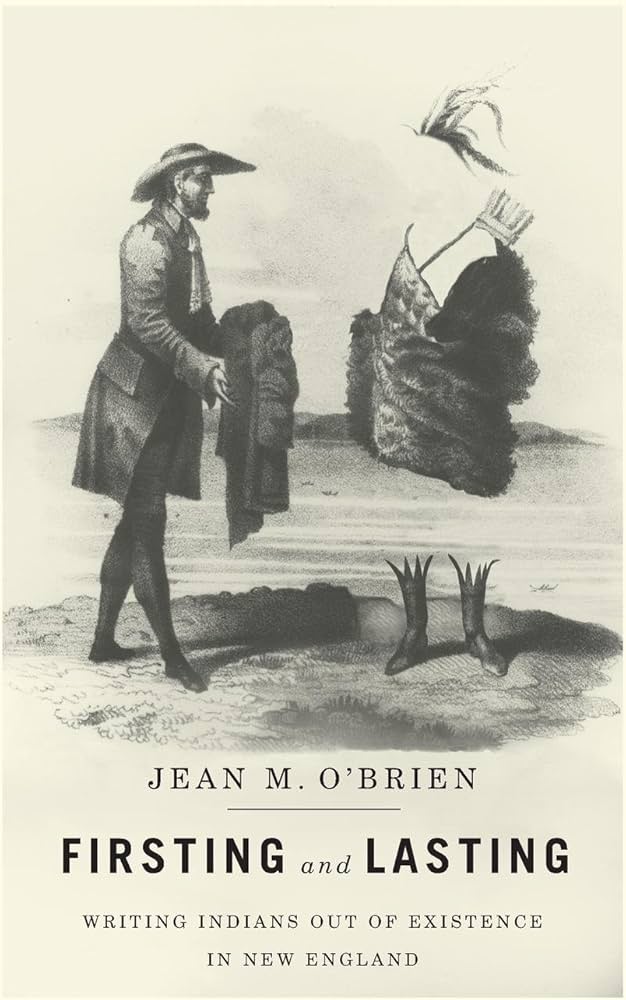
I found this book through the work of Kanaka Maoli anarchist critic J. Kēhaulani Kauanui and ended up relying on it for a lot of my research into settler colonialism in NH, but I didn't get a chance to read it in full til the end of the project. I wish I’d read it sooner. By helping me understand the process New England settlers used to construct their history and sovereignty, O'Brien’s work has colored the way I engage with US history ever since. In showing its machinery, its structure, O’Brien’s work also helps me to see the vulnerable points in the US colonial project and imagine a future beyond its end.
Though they lived long after the colonizers who signed declarations, treaties, and deeds of sale, local historians in the 1800s cemented the US national project by imagining a national history. This colonial nationalism (like all nationalisms) was not a fact but an argument they made, a historical master-narrative that excluded all other notions of place. The narrative, which O’Brien calls a “script,” goes like this: English civilization arrived and overcame the Indians; assimilated them, killed them, and sent them west; made their society and sovereignty vanish along the path of the frontier. In the land they conquered, the English made the “wilderness” “blossom like a rose,” establishing civilization where none existed before. Nineteenth-century historians imagined everything the English built as being “first” in the land, unprecedented by the Native society that came before it, whose history is not “history” at all. What it actually was, of course, they barely bother to ask.
As they imagined their “firsts” colonial historians were increasingly preoccupied with Indian “lasts.” Colonial communities frequently marked the loss of the “last” Indians in their town limits, or the final killings between Indians and white folk, together with the final recorded sightings of bears, deer, and other “wilderness” creatures. They were conscious of, and even sometimes remorseful about the brutality of their local colonial wars, including King Phillip's Rebellion and the Pequot War. Each imagined Indian “last” was a precious, romanticized thing in their consciousness. All were framed within a racial mythology that doomed Indigenous peoples to disappearance. The supposed end of all things Indian formed the contrasting backdrop of all things emergent and modern, all things American.
Despite their supposed vanishing act in US national consciousness, Native people were actually manifest in civic life. Their presence was noted, again and again, even by the colonizers’ own metrics and structures of power. Colonial racial imagination, which O’Brien calls “blood mythology,” assured whites that Native people either were or would soon be bred out of existence — even as contemporary whites feared their own purity as a race, facing early immigration from Ireland, Wales, and Scotland. Simultaneous to their claims of Indian “extinction,” New England governments administered “guardianship systems” over local Indian tribes, which they recognized by name as distinct civic groups of Native people living on their native land. More than that, they tracked Indians in formal census data, producing concrete numbers of Indigenous people still living in the regions that whites described, pervasively, as void of Indian life and culture. Records were even available to colonial historians (who of course were not interested) revealing the colony’s clear and ongoing brutality towards Indigenous people, not at all passive or natural, but intentional. Statistical estimates attested the clear disproportion of Indian children orphaned from their families, and the massive over-representation of Indian kids and adults in indentured servitude, their labor captured even as their existence was denied.
Meanwhile, Indians in New England narrated their own counterhistories and tribal nationalisms. Easily my favorite part of this book is O’Brien’s take on the life of William Apess, a Pequot preacher who was adopted into the Mashpee tribe for his political advocacy and leadership in the community. Apess wrote and orated extensively on the national sovereignty of Indians within colonial New England in the mid-nineteenth century, when white writers in communities only miles away were claiming that his nation was not only subordinate but extinct. In his Eulogy on King Philip, Apess invited “every man of color” to “wrap himself in mourning” on the Americans’ 4th of July. He praised the violent rebellion of Metacom, Sachem of the Wampanoag nation, who led Indians of many tribes against colonial persecution. “Taken together,” O’Brien writes, “Apess’s vision obliterates ideas that lay at the center of the New England project of nationalism”.
The first step to revolting against a system of genocide and domination is to learn that system’s history, and how it works. O’Brien’s book has done more than any other this year to not only illuminate this complicated history to me, but also inspire and engross me in its telling. It leaves readers with a critical understanding of sovereignty as a question of power, and the tools to deconstruct and understand the national narrative. I hope you give it a try, or at least read a Wiki article or something about William Apess, the Pequot War, Metacom’s Rebellion, or any other history of Indigenous struggle across Turtle Island.
thanks for reading my blog. you can get this in email form at my buttondown. i also post on instagram and substack @everzines. email me at eviewrites@duck.com.
yours,
evergreen<3